
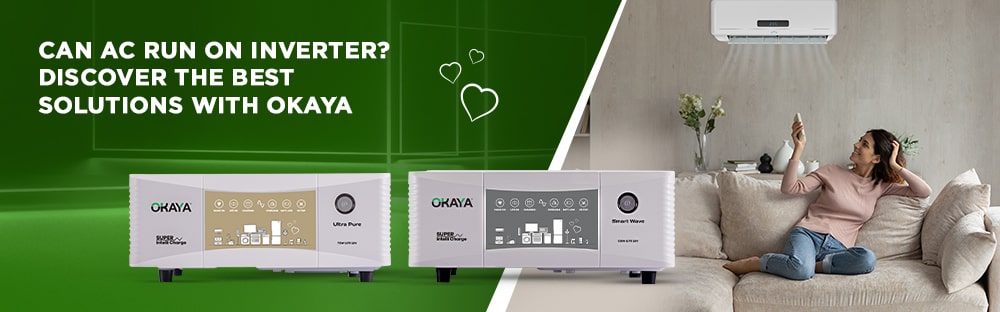
When the summer heat becomes unbearable, an air conditioner (AC) can be a lifesaver — but what happens during a power outage? Yes, an AC can run on an inverter, provided the inverter has enough capacity for both the AC's running load and its startup surge, and is built on a sine wave technology suited to motor-based appliances. Here's how to size and choose the right setup.
Yes. An air conditioner can run on an inverter as long as the inverter's VA capacity comfortably covers the AC's power draw and the inverter is paired with an adequately sized battery bank. Not every inverter is suitable — a standard Home UPS built for lights, fans, and basic appliances is generally undersized for an AC, so a high-capacity inverter is typically needed.
An air conditioner's compressor is a motor-based load, which makes waveform quality important. Modified sine wave inverters produce a rougher, stepped output that can stress motor-based appliances over time, while true sine wave inverters provide a smooth, grid-like current that's safer for sensitive and high-power appliances like ACs. Okaya's Hi-Capacity UPS range (Power MAX Series) runs on Advanced True Sine Wave (ATSW) technology, designed for exactly this kind of heavy-duty, motor-based load.
Two numbers matter when sizing an inverter for an AC: its running (rated) wattage, and its starting or surge wattage — the brief spike a compressor draws when it switches on, which is typically higher than the running wattage. Always check the AC's nameplate rating for both figures rather than relying on tonnage alone, since actual draw varies by star rating and model.
Okaya's high capacity inverter for home range (Power MAX Series) covers a range of VA capacities: ATSW3050 (2500 VA, 24V) and ATSW3750 (3200 VA, 24V) may suit many 1-1.5 ton AC setups, subject to the AC's actual running wattage, starting/surge requirement, and any additional connected load, while ATSW4550 (4000 VA, 48V) or ATSW6650 (6100 VA, 48V) generally suit 2-ton-and-above units or setups running an AC alongside other heavy appliances. Leaving headroom above the AC's rated wattage helps absorb the compressor's starting surge.
Because these VA ratings run on 24V or 48V systems, they're typically paired with two or four batteries connected in series rather than a single battery — see our guide on battery pairing and compatibility for how this setup works.
Yes. A typical 1.5 ton AC generally draws around 1500-1800W of running power (varying by star rating), with a higher compressor starting surge. An inverter in the 2500-3200 VA range (24V) — such as Okaya's ATSW3050 or ATSW3750 — is generally suitable, provided the actual nameplate wattage of the specific AC model is checked before finalizing the setup.
Most 1.5 ton split ACs draw approximately 1500-1800W during normal running, though this depends on the unit's energy efficiency (star) rating and compressor type — inverter-technology ACs typically draw less on average than fixed-speed ACs. The startup surge is higher than this running figure, which is why sizing an inverter on tonnage alone can under-size the setup; always check the specific AC model's nameplate rating.
Runtime depends on the battery bank's total capacity (Ah), how deeply it's discharged, the inverter's efficiency, and the AC's actual power draw — an AC is a heavy, continuous load, so its backup runtime is generally shorter than for lighter appliances like lights or fans on the same battery bank. Okaya's Certified Backup Hours (CBH) rating provides verified battery-runtime information under defined test loads; actual AC backup time will still depend on the battery bank, AC load, inverter efficiency, and operating conditions.
Okaya's Hi-Capacity UPS range (Power MAX Series) is built for heavier loads such as air conditioners, motors, and commercial equipment. Key features include:
Advanced True Sine Wave (ATSW) Technology: Delivers a smooth, grid-like current suited to motor-based appliances like AC compressors.
Super Intelli Charge: An advanced charging profile with Boost-to-Float charging, designed to support faster, efficient charging and battery health.
EI Core Design: Helps minimize heat generation and power loss, supporting energy-efficient operation and the operational lifespan of the UPS.
Protection Features: Overload, low/high-battery, short-circuit, over-temperature, reverse polarity, and battery deep-discharge protection — suited to the heavier-duty demands of running an AC.
Browse the full Hi-Capacity UPS models by VA rating, or explore the heavy duty inverter range on shop.okaya.in.
For more on choosing between capacities, see our guides on why high-capacity inverters are essential for heavy-duty power needs and Hi-Capacity UPS for large homes and offices.
Running an AC on an inverter is possible and practical with the right setup — a correctly sized Hi-Capacity inverter, a matched battery bank, and realistic runtime expectations based on your actual load.
Can an inverter run an air conditioner?
Yes, provided the inverter's VA capacity covers both the AC's running wattage and its higher compressor starting surge, and the inverter uses a sine wave technology suited to motor-based loads. A standard Home UPS is usually undersized for an AC — a Hi-Capacity inverter is generally needed.
How many watts or VA inverter do I need for a 1.5 ton AC?
A 1.5 ton AC typically draws around 1500-1800W running, so an inverter in the 2500-3200 VA (24V) range is generally suitable, with some headroom for the compressor's starting surge. Always confirm the exact wattage on the specific AC's nameplate before finalizing the inverter size.
What type of inverter is best for running an AC?
A true sine wave inverter is recommended over a modified sine wave inverter, since its smooth, grid-like output is better suited to motor-based compressor loads and reduces the risk of stress on the AC over time.
How long can an AC run on an inverter and battery backup?
Runtime depends on the battery bank's capacity, how deeply it's discharged, the inverter's efficiency, and the AC's actual power draw. Because an AC is a heavy continuous load, its backup runtime is generally shorter than for lighter appliances on the same battery bank. Okaya's Certified Backup Hours (CBH) rating provides verified battery-runtime information under defined test loads, but actual AC backup time will still depend on the battery bank, AC load, inverter efficiency, and operating conditions.
Can I run a 2 ton AC on an inverter?
A 2-ton AC may require a 4000-6100 VA class inverter depending on its actual running wattage, compressor starting requirement, and any additional connected loads. Always verify the AC's nameplate rating and the inverter's surge capability before finalizing the setup, along with a correspondingly larger battery bank.
Do I need a special battery setup to run an AC on an inverter?
Higher-VA inverters used for ACs typically run on 24V or 48V systems, which means pairing two or four batteries in series rather than a single battery, so the battery bank's voltage and capacity match the inverter's requirements.
 OKAYA POWER PVT. LTD.
ENERGIS D-7, 3rd & 4th Floor, Rohtak Rd,
Udyog Nagar, Mangolpuri,
New Delhi - 110041, INDIA
OKAYA POWER PVT. LTD.
ENERGIS D-7, 3rd & 4th Floor, Rohtak Rd,
Udyog Nagar, Mangolpuri,
New Delhi - 110041, INDIA
© 2026 All Rights Reserved to Okaya Power Private Limited

